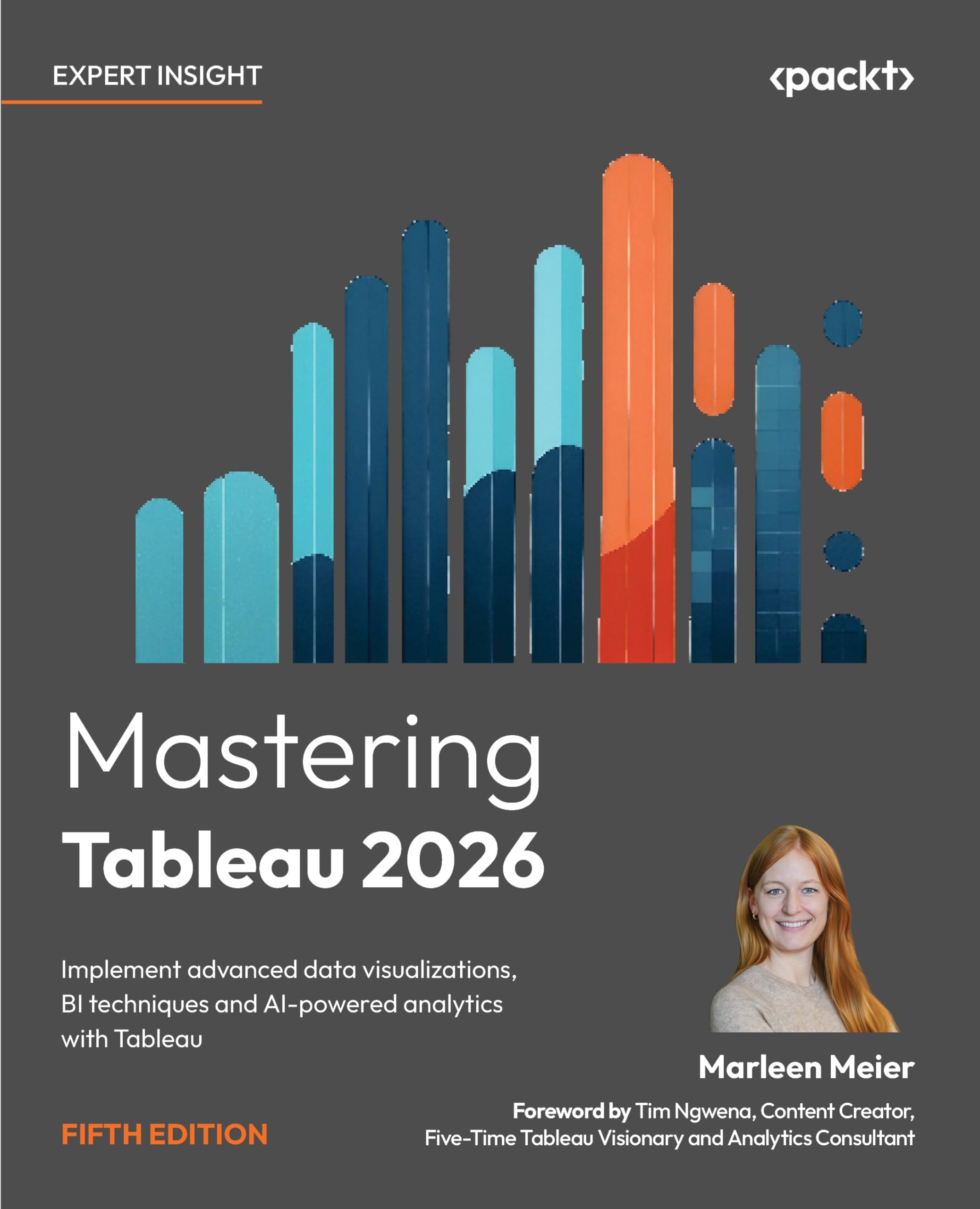
Mastering Tableau 2026: Implement advanced data visualizations, BI techniques and AI-powered analytics with Tableau
Product ID: 803824518
Buy anything from 5,000+ international stores. One checkout price. No surprise fees. Join 2M+ shoppers on Desertcart.
Desertcart purchases this item on your behalf and handles shipping, customs, and support to Seychelles.
Build, design, and improve advanced business intelligence solutions using Tableau's newest updates, including Tableau Desktop, Prep Builder, Server, and AI-powered features to drive data-driven decision-making. Free with your book: DRM-free PDF version + access to Packt's next-gen Reader* Key Features Build advanced Tableau dashboards and data visualizations for business intelligence Leverage Tableau AI features, automated insights, and LOD expressions to accelerate analysis Master Tableau Prep Builder, Server, and advanced analytics, including time series and geospatial Book Description Master the full capabilities of Tableau to design, build, and scale modern data visualization and business intelligence solutions. This book takes you beyond the basics to help you create advanced Tableau dashboards, perform efficient data preparation with Tableau Prep Builder, and deliver impactful analytics across your organization. Through practical examples, you’ll learn how to turn raw data into meaningful insights using proven Tableau data visualization techniques. As you progress, you’ll work with calculated fields and LOD expressions to build more flexible and powerful analyses. You’ll also explore performance optimization, deployment, and collaboration using Tableau Server, along with best practices for data governance and security in enterprise environments. In addition, the book covers AI-powered Tableau features that enhance analysis and accelerate insight discovery. You’ll apply advanced techniques such as time series analysis, geospatial analytics, and data modeling, and extend Tableau’s capabilities through Python and R integration for more sophisticated analytics workflows. By the end of this book, you’ll be equipped to build scalable, high-performance Tableau analytics solutions, enabling you to solve complex business problems with confidence. What you will learn Learn Tableau components like calculated fields and LOD expressions Master Tableau Prep Builder with all its features and settings Explore and implement data analytics with Python and R Use Tableau Exchange for accelerators, extensions, and connectors Interact with Tableau Server to understand its functionalities Study advanced visualizations and dashboard creation techniques Master self-service, time series, and geo-spatial analytics Learn to implement data governance and AI-powered features Who this book is for This book is designed for business analysts, business intelligence professionals, and data analysts who want to master Tableau to solve a range of data science and business intelligence problems. Prior exposure to Tableau will help you get to grips with the features more quickly, but it’s not a prerequisite. Table of Contents Reviewing the Basics Cleaning Your Data Using Tableau Prep Builder Learning about Joins, Blends, and Data Structures Introducing Table Calculations Utilizing OData, Data Densification, Big Data, and Google BigQuery Practicing Level of Detail Calculations Going Beyond the Basics Working with Maps Designing Dashboards and Best Practices for Visualizations Leveraging Advanced Analytics Improving Performance Exploring Tableau Server and Tableau Cloud Integrating Programming Languages The Intelligent Era of Tableau AI, Pulse, and Next Developing Data Governance Practices Review: Clear and Concise Guide. A Must Have Resource for Any Data Analyst. - If you are a data analyst, sales professional, marketer, engineer, financial analyst, developer or data enthusiast and have never used Tableau, I suggest that you add to your toolkit author, Marleen Meier’s Mastering Tableau 2026 5th Edition. Tableau, which is owned by Salesforce is a very versatile platform for analyzing data and creating colorful visualizations and dashboards which can be made accessible online, by desktop and by phone. With the release of Tableau 2026 and the addition of Tableau AI, Pulse and Next, Meier dives into practical examples and theory to assist the reader. Mastering Tableau 2026 covers 17 chapters and begins with a review of visualizations, dashboards, worksheets, stories, data sets and calculations. Meier tackles data cleansing in Chapter 2 which is essential to present data in metrics that make sense to the AI semantic layer. Data cleansing covered in the 3rd chapter covers Prep Builder which can execute jobs to clean your data with a button’s click. Careful designing of union and join statements with proper alignment of datasets must be carefully set up for Prep Builder to function in a way that’s useful. In chapter 4, Meier dives deep into data structures with joins and blends which is arguably the most beneficial to the beginning user if you must reference static CSV or Excel files or even if you are a SQL expert. She covers Spatial joins which is a beneficial topic if you work with Esri, GeoJSON and Shape files specifically when mapping a geographical region or longitude and latitude coordinates to highlight clusters of data per any geographical location around the globe. The next couple of chapters highlight more information on geographical blends and data analysis than any other Tableau book I’ve used and that may be due to an increase in supply chain analysis across industries. Chapter 15 dives into The Intelligent Era of Tableau AI, Pulse, Next Metrics layer and Tableau Semantics. Metrics Layer provides a single, governed definition of your business data that serves as the source of insights and understanding. Tableau Semantics builds upon this concept with the AI-injected semantic layer or Tableau Semantics. Tableau Semantics adds business context, definition and data relationships. These links and relationships to other data fields and categories allows AI agent to provide accurate answers to inquiries. Tableau Pulse provides high-level monitoring of your metrics to track and highlight changes in trends. Pulse provides its' responses to your inquiries in plain language which tells you the reasoning for any changes in trends or metrics. Tableau Pulse answers what happened, Tableau Next asks what should we do about it, Einstein Discovery answers predictive questions, “Why did it happen and what will happen next?” Einstein Discovery is likened to an embedded data scientist which uses Automated Machine Learning (AutoML) to statistically analyze your data, reveal hidden patterns and generate predictions. All of these AI tools are included in the Tableau ecosystem which necessitates building trustworthy semantic foundations. Later chapters in Mastering Tableau 2026 include information on advanced analytics in which data correlation and interpolation. The end of the book focuses on Tableau performance, Governance, Tableau Cloud, and implementation of programming languages for all the developers of R and Python using the programming tool integration. Tableau desktop can be downloaded for free to follow along for the book’s examples or Tableau Public which is a free online tool used if you would like to make your visuals public. There is a wealth of examples packed into this resource and is a must have, even for PowerBI users. Review: Essential guide for both beginners and advanced Tableau users - As a former Senior Support Engineer for Salesforce (Tableau products), I can confidently say that the 5th Edition of Mastering Tableau 2026 by Marleen Meier is an essential guide for both beginners and advanced users. I found the explanations of core concepts such as dimensions versus measures and discrete versus continuous fields exceptionally clear, helping new users avoid common mistakes. For experienced professionals, the book excels in advanced topics like table calculations, Level of Detail (LOD) expressions, and Tableau’s order of operations. I especially appreciated the strong focus on data preparation, joins, relationships, and Tableau Prep Builder, which are critical for performance optimization. Chapter 12 stood out to me because of its detailed explanation of performance tuning, governance, and database optimization techniques. The book also impressed me with its coverage of modern 2026 features, including Tableau AI, Tableau Pulse, Tableau Next, and agentic analytics capabilities. In addition, the integration with Python and R for predictive modeling and advanced analytics demonstrates the platform’s full potential. Overall, I see this book as a complete architectural blueprint for building scalable, high-performance Tableau environments while avoiding countless troubleshooting issues later on.


| Best Sellers Rank | #409,535 in Books ( See Top 100 in Books ) #75 in Business Intelligence Tools #103 in Data Modeling & Design (Books) #985 in Computer Science (Books) |
| Customer Reviews | 4.9 out of 5 stars 13 Reviews |
D**.
Clear and Concise Guide. A Must Have Resource for Any Data Analyst.
If you are a data analyst, sales professional, marketer, engineer, financial analyst, developer or data enthusiast and have never used Tableau, I suggest that you add to your toolkit author, Marleen Meier’s Mastering Tableau 2026 5th Edition. Tableau, which is owned by Salesforce is a very versatile platform for analyzing data and creating colorful visualizations and dashboards which can be made accessible online, by desktop and by phone. With the release of Tableau 2026 and the addition of Tableau AI, Pulse and Next, Meier dives into practical examples and theory to assist the reader. Mastering Tableau 2026 covers 17 chapters and begins with a review of visualizations, dashboards, worksheets, stories, data sets and calculations. Meier tackles data cleansing in Chapter 2 which is essential to present data in metrics that make sense to the AI semantic layer. Data cleansing covered in the 3rd chapter covers Prep Builder which can execute jobs to clean your data with a button’s click. Careful designing of union and join statements with proper alignment of datasets must be carefully set up for Prep Builder to function in a way that’s useful. In chapter 4, Meier dives deep into data structures with joins and blends which is arguably the most beneficial to the beginning user if you must reference static CSV or Excel files or even if you are a SQL expert. She covers Spatial joins which is a beneficial topic if you work with Esri, GeoJSON and Shape files specifically when mapping a geographical region or longitude and latitude coordinates to highlight clusters of data per any geographical location around the globe. The next couple of chapters highlight more information on geographical blends and data analysis than any other Tableau book I’ve used and that may be due to an increase in supply chain analysis across industries. Chapter 15 dives into The Intelligent Era of Tableau AI, Pulse, Next Metrics layer and Tableau Semantics. Metrics Layer provides a single, governed definition of your business data that serves as the source of insights and understanding. Tableau Semantics builds upon this concept with the AI-injected semantic layer or Tableau Semantics. Tableau Semantics adds business context, definition and data relationships. These links and relationships to other data fields and categories allows AI agent to provide accurate answers to inquiries. Tableau Pulse provides high-level monitoring of your metrics to track and highlight changes in trends. Pulse provides its' responses to your inquiries in plain language which tells you the reasoning for any changes in trends or metrics. Tableau Pulse answers what happened, Tableau Next asks what should we do about it, Einstein Discovery answers predictive questions, “Why did it happen and what will happen next?” Einstein Discovery is likened to an embedded data scientist which uses Automated Machine Learning (AutoML) to statistically analyze your data, reveal hidden patterns and generate predictions. All of these AI tools are included in the Tableau ecosystem which necessitates building trustworthy semantic foundations. Later chapters in Mastering Tableau 2026 include information on advanced analytics in which data correlation and interpolation. The end of the book focuses on Tableau performance, Governance, Tableau Cloud, and implementation of programming languages for all the developers of R and Python using the programming tool integration. Tableau desktop can be downloaded for free to follow along for the book’s examples or Tableau Public which is a free online tool used if you would like to make your visuals public. There is a wealth of examples packed into this resource and is a must have, even for PowerBI users.
A**L
Essential guide for both beginners and advanced Tableau users
As a former Senior Support Engineer for Salesforce (Tableau products), I can confidently say that the 5th Edition of Mastering Tableau 2026 by Marleen Meier is an essential guide for both beginners and advanced users. I found the explanations of core concepts such as dimensions versus measures and discrete versus continuous fields exceptionally clear, helping new users avoid common mistakes. For experienced professionals, the book excels in advanced topics like table calculations, Level of Detail (LOD) expressions, and Tableau’s order of operations. I especially appreciated the strong focus on data preparation, joins, relationships, and Tableau Prep Builder, which are critical for performance optimization. Chapter 12 stood out to me because of its detailed explanation of performance tuning, governance, and database optimization techniques. The book also impressed me with its coverage of modern 2026 features, including Tableau AI, Tableau Pulse, Tableau Next, and agentic analytics capabilities. In addition, the integration with Python and R for predictive modeling and advanced analytics demonstrates the platform’s full potential. Overall, I see this book as a complete architectural blueprint for building scalable, high-performance Tableau environments while avoiding countless troubleshooting issues later on.
L**R
A must-read book
The book is a comprehensive and forward-thinking guide that successfully bridges foundational Tableau knowledge with the rapidly evolving world of AI-powered analytics and data governance. The book stands out for its practical, hands-on approach, walking readers through real-world examples ranging from dashboard design and data preparation to advanced analytics, geospatial visualizations, and integrations with Python and R. The addition of new chapters focused on Tableau AI, Tableau Pulse, Tableau Next, and governance practices makes the book especially relevant for modern analytics professionals working in enterprise environments. The author demonstrates a clear understanding that today’s BI landscape is no longer only about creating dashboards but also about building trustworthy, scalable, AI-enabled data ecosystems. Overall, the book is an excellent resource for analysts, BI professionals, Tableau developers, and aspiring data leaders who want to move beyond beginner dashboards into advanced analytics, governance, and AI-driven insights. It is both technically rich and highly practical, making it one of the most complete Tableau learning resources currently available.
A**S
A complete path through the Tableau infrastructure
Mastering Tableau delivers a fairly complete path through the Tableau universe. This book is unique in that it starts off with Tableau Prep, and some initial data preparation steps in a concise yet complete way for beginners to understand, and works its way past just working with data and creating dashboards. After hitting the high points of Tableau desktop, with helpful explanations and examples, from initial basics to more complex uses that would serve most creative or corporate applications, there is a pivot where most product focused books don't go. This dives into Tableau Server, and where it fits into the Salesforce ecosystem, using other language packages with Tableau, and the AI powered features like Tableau Pulse and Next. Finally, there is a short but valuable section on data governance guidelines. If you're looking for something to start your journey into Tableau and understanding the entire ecosystem, this book is a good start.
J**B
Mastering Tableau 2026 (5th Edition) — Clear, Practical, and Worth Your Time
I'm about 250 pages into this book and already finding it genuinely useful. I've been building Tableau dashboards for a data analytics portfolio and picked this up to sharpen my skills — and so far it's delivering. What stands out most is the writing style. Marleen Meier explains concepts clearly without talking down to the reader or burying you in jargon. The continuous vs. discrete distinction — something that trips up a lot of Tableau users — is handled particularly well. The follow-along examples are another strength. Rather than just explaining how things work in theory, the book walks you through building real visualizations step by step. That hands-on approach makes the material stick in a way that passive reading doesn't. I'm giving it four stars rather than five because I haven't finished it yet and want to be honest about that. Based on what I've read, though, this is shaping up to be one of the more practical Tableau resources available — especially for intermediate users who want to move beyond the basics and build work they're genuinely proud of.
E**D
Mastering Tableau 2026 - A Great Way to Get Started or Level Up your Skills
I’m a 4x Tableau Ambassador and I've been using Tableau for 14 years, and I still leveled up my skills with this book. I really enjoyed the Build a Playground and Follow Along Dashboard sections, which offer really good hands-on training. The build a playground gives you the fundamental understanding of the feature and the follow along dashboard shows you how to use it with real world analytics. But Marleen Meier didn’t stop with fundamentals and real world examples. She delivered on mastering design, data management, and data governance. Mastering Tableau 2026 will help you on your path to learning the whole Tableau universe.
J**I
An Informative Tome Worth Reading Cover-to-Cover
I'm a 17-year Tableau practitioner and BI Analytics Manager, and I appreciate the thoroughness of this book. I felt like the examples were plentiful and thoughtful, and the subject matter covered was wide in scope - all while still maintaining relevance to the skills that get you the most bang for your buck in the program. The content is approachable enough for novices but detailed enough for the most sincere students of the craft. The fact that this book covers technical features of Tableau, design, data governance, and more makes it an essential one-stop tome of info that someone could reference for years to come. 10 out of 10, would highly recommend!
N**K
Mastering Tableau 2026
Mastering Tableau 2026 is a strong resource for professionals looking to advance their Tableau and business intelligence skills. The book effectively combines advanced data visualization techniques with practical real-world analytics applications. Its coverage of AI-powered analytics and modern BI trends makes it highly relevant for today’s data-driven organizations. Overall, it is best suited for intermediate to advanced users aiming to build scalable, insightful, and impactful dashboards.
Trustpilot
1 week ago
1 week ago